Staffing agencies and recruitment firms that place contractors earn the gap between two rates: what the client pays per hour and what the contractor is paid per hour. Every hour tracked therefore has to do two jobs at once, appearing on the client's invoice at the bill rate and on the contractor's pay record at the pay rate. The right time tracker records each hour once, attaches both rates, and produces the invoice and the payslip from the same approved record.
When those two documents are built separately, from different spreadsheets or at different times, agencies leak margin through missed hours, rate mistakes and disputes that delay payment on both sides.
This guide explains the economics of placed-contractor billing, where agencies lose money, the workflow that keeps billing and pay aligned, and how StaffVertex supports it.
How placed-contractor billing works
Pay rate: what the agency pays the contractor per hour.
Bill rate: what the agency charges the client per hour for that contractor.
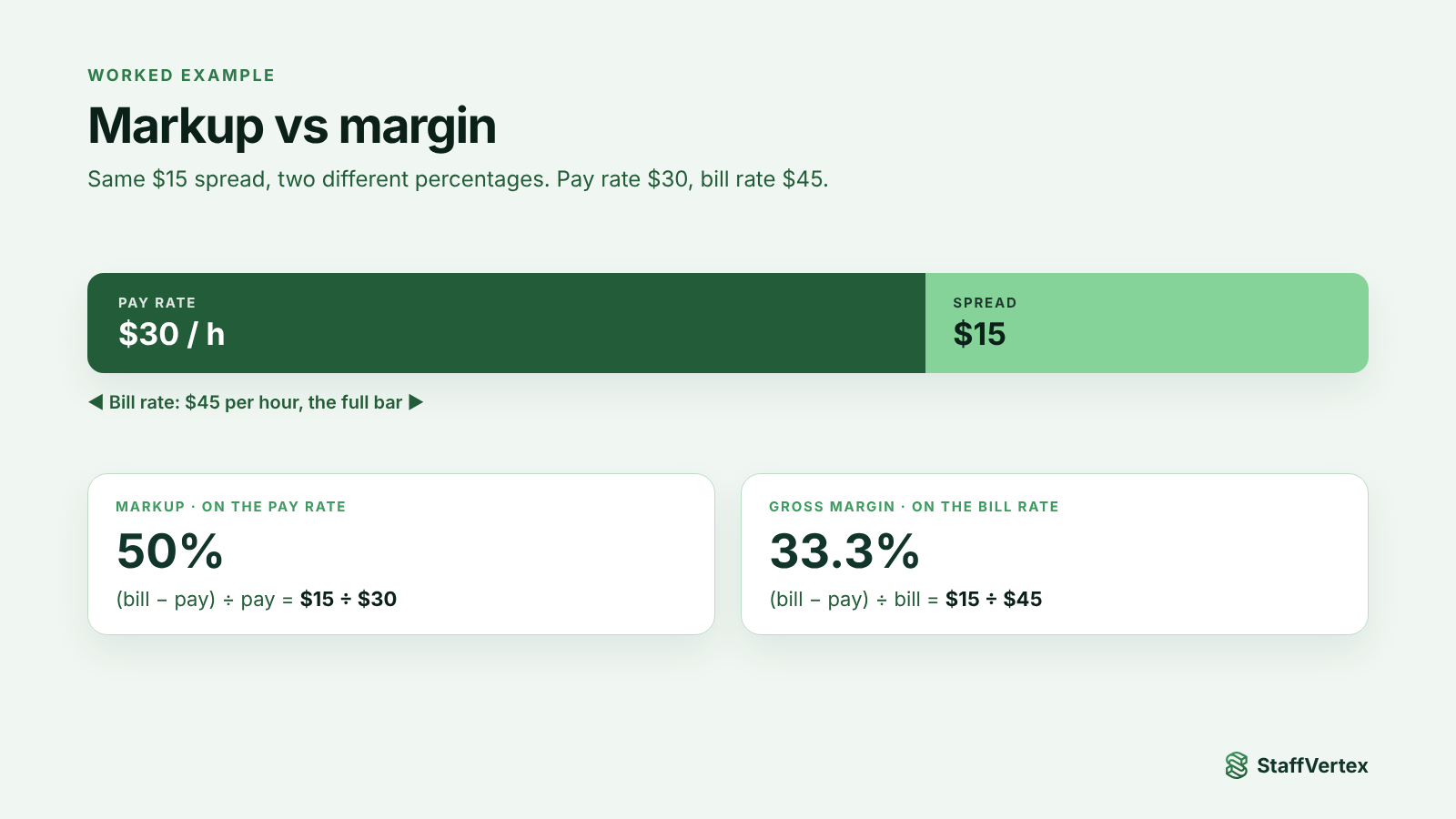
Markup: the difference as a percentage of the pay rate: (bill − pay) ÷ pay.
Gross margin: the difference as a percentage of the bill rate: (bill − pay) ÷ bill.
Markup and margin are often confused, and the difference matters when you quote clients or set targets.
Worked example
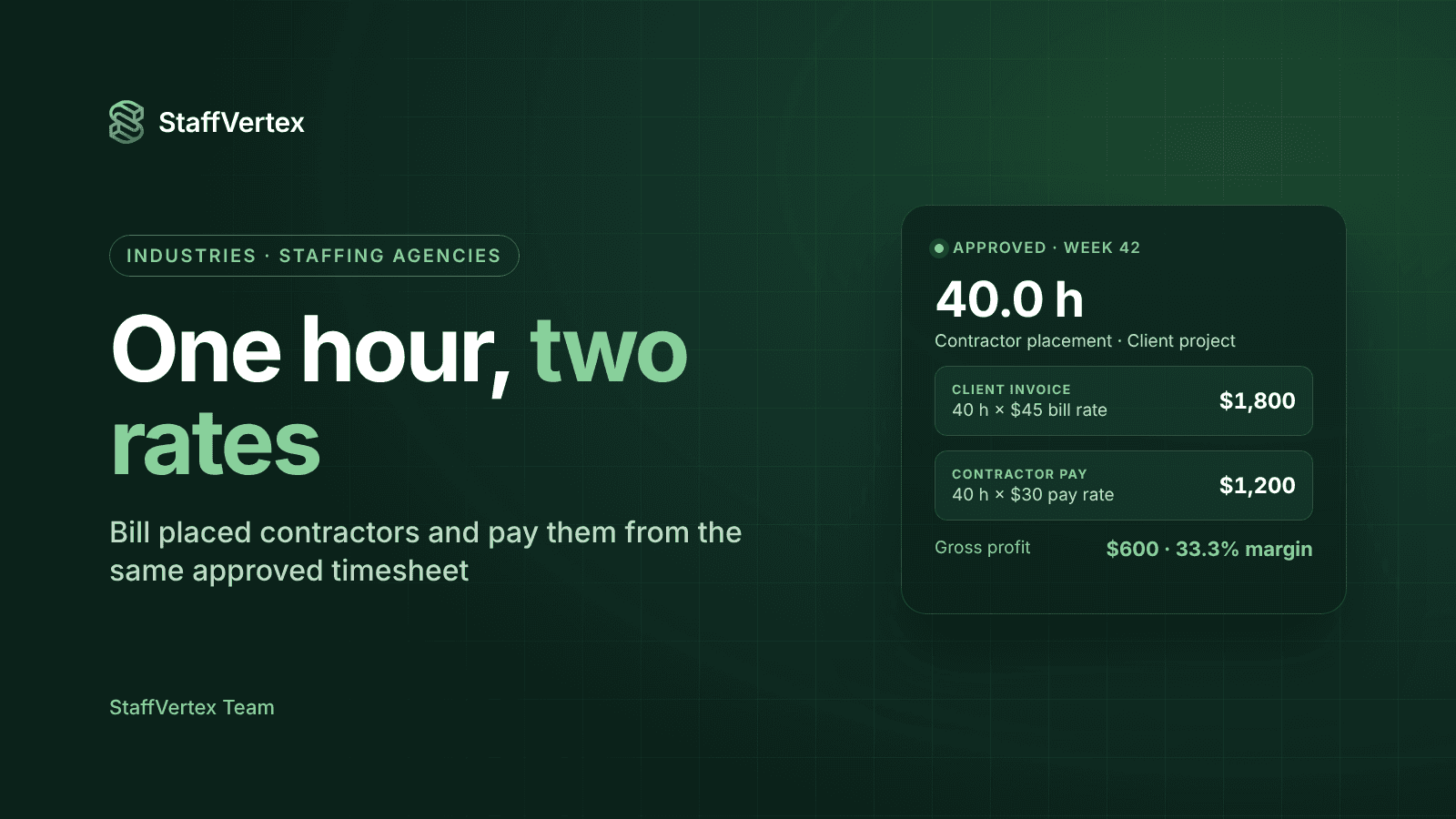
A contractor is paid $30 an hour and billed to the client at $45 an hour, and works 40 hours in a week.
Item | Calculation | Amount |
|---|---|---|
Client invoice | 40 × $45 | $1,800 |
Contractor pay | 40 × $30 | $1,200 |
Gross profit | $1,800 − $1,200 | $600 |
Markup | $15 ÷ $30 | 50% |
Gross margin | $15 ÷ $45 | 33.3% |
For employees placed on assignment, remember that employer taxes, insurance and benefits come out of that gross profit, so the true margin is lower.
Now imagine two hours are missed from the timesheet. The agency loses $90 of billing but saves only $60 of pay if the contractor also goes unpaid, which damages the relationship. More often, the contractor reports the hours later and is paid, while the invoice has already gone out without them, and the agency absorbs the full $60 cost with no revenue.
Where staffing agencies lose money on time
Late or missing timesheets. Contractors submit hours days after the week ends, or not at all, delaying both invoicing and pay.
Paper and spreadsheet timesheets. Hours are retyped by the agency, introducing errors and creating no audit trail.
Rate mistakes. The wrong bill rate or pay rate is applied, especially after a rate change or when a contractor works for two clients.
Invoices and pay built separately. The invoice goes out before late hours arrive, so hours are paid but never billed.
Disputed hours. A client questions a timesheet and nobody can show when or how the hours were worked.
Remote contractors with no visibility. For remote placements, clients increasingly ask for evidence that billed hours were worked.
Slow cycles. Monthly invoicing while paying contractors weekly ties up cash in the gap.
The workflow: one record, two documents
Set up each placement as a project. One project per client engagement, with the client's bill rate attached.
Attach the contractor's pay rate. Store it on the contractor's profile, or on the project if pay differs per placement.
Contractors track time in real time. A desktop timer against the placement project, with offline support for patchy connections and idle prompts for fairness.
Share hours with the client for sign-off. Send a report of the contractor's hours for the period, and agree in the contract how sign-off works.
Approve before the cut-off. The agency approves the period once the client confirms, locking the hours.
Generate both documents together. At the end of the cycle, produce the client invoice at the bill rate and the contractor's payslip at the pay rate from the same approved hours.
Pay and collect. Pay the contractor through your usual method and send the invoice to the client.
Keep the audit trail. Retain time logs, approvals and any manual corrections with reasons, in case of disputes or audits.
Match your cycles. If you pay contractors weekly, consider invoicing clients weekly or bi-weekly too, so cash does not sit in the gap.
How StaffVertex supports staffing agencies
StaffVertex was built around the bill-rate and pay-rate model that staffing agencies run on.
Both rates in one place. Hourly projects carry a bill rate for the client and a pay rate. Each contractor can also have their own pay rate on their profile, which takes priority; if none is set, the project's pay rate applies.
Automatic client invoices. At the end of each cycle, StaffVertex totals the hours worked on the project and produces an invoice with total hours and amount at the bill rate. The per-contractor breakdown stays in the project report for client sign-off.
Automatic contractor payslips. The same hours produce a payslip for each contractor at their pay rate, with a paid or unpaid status and their bank details shown for them to verify.
Separate cycles where you need them. Set the organization's invoicing cycle (weekly, bi-weekly, monthly or annual) and override the pay cycle for individual contractors, for example paying weekly while invoicing monthly.
Real-time tracking for remote placements. A Windows and Mac desktop app with offline tracking, idle prompts, activity monitoring and optional, blurrable screenshots gives clients confidence in remote contractors' hours.
Access control. Custom roles and permissions let you decide exactly who sees which projects and reports.
Pricing is per seat: Pro $4 and Business $9 per month on monthly billing, with invoices and payslips on Business (pricing). On the worked example above, Business costs $9 a month per contractor against $600 of weekly gross profit.
Consider: StaffVertex tracks time from a desktop app. For contractors on job sites who clock in from phones with GPS, a mobile-first attendance tool may suit better.
Compliance notes
General information only; rules vary by country and state, so take local advice.
Classification. Whether a placed worker is your employee, an independent contractor or the client's employee has major tax and legal consequences. In the US, the IRS explains the tests in its guide to independent contractor vs. employee status. Get it right for each placement and document it.
Overtime. Placed employees may be entitled to overtime under local law, for example time and a half over 40 hours a week for non-exempt workers in the US. Agree with clients in advance how overtime is billed.
Record keeping. Keep time records, approvals, rates and pay records for the period your law requires.
Monitoring notices. If you use activity monitoring or screenshots for remote contractors, tell them in writing and follow local monitoring rules.
Cross-border contractors. Agree currency, payment method and paperwork in the contract, and check tax documentation requirements for the countries involved.
Try StaffVertex for your placements
Start a free 14-day StaffVertex trial, set up one placement with its bill and pay rates, and see the invoice and payslip generated from the same hours. No card is required.