Time tracking for marketing agencies is less about billing every minute and more about one question: is each client profitable? Whether you charge a monthly retainer, a project fee or an hourly rate, tracked hours show your effective hourly rate per client, reveal over-servicing before it becomes a habit, and give you evidence when it is time to renegotiate scope.
Most agencies know which clients feel demanding. Far fewer know, in numbers, which retainers are quietly losing money because content, reporting, ad tweaks and account calls creep past what the fee was built to cover.
This guide explains how each pricing model uses time data, shows how over-servicing erodes margin, sets out a practical way to structure tracking in an agency, and describes a monthly profitability routine.
Retainers, projects and hourly work
Pricing model | How you earn | What time data tells you |
|---|---|---|
Monthly retainer | A fixed fee for an agreed scope, such as social, SEO or paid media management | How many hours the fee really buys, and whether scope is creeping |
Project fee | A fixed price for a campaign, website or brand project | Whether the quote was right, and where the hours went |
Hourly | Hours × rate, invoiced each cycle | Exactly what to bill, with a record to back it up |
Performance or hybrid | A base fee plus a bonus on results | The cost of delivering results, so the base fee covers it |
In every model except hourly, the client never sees an invoice line for hours. That is exactly why agencies stop tracking them, and exactly why margins slip without anyone noticing.
If you are still choosing a model, the U.S. Chamber of Commerce has a short guide to pricing services that compares hourly and per-project pricing.
Over-servicing: the silent margin killer
Over-servicing happens when the team delivers more hours than a fee was designed to cover. It rarely comes from one big request; it comes from an extra revision, an unplanned report, a longer call, a quick favor.
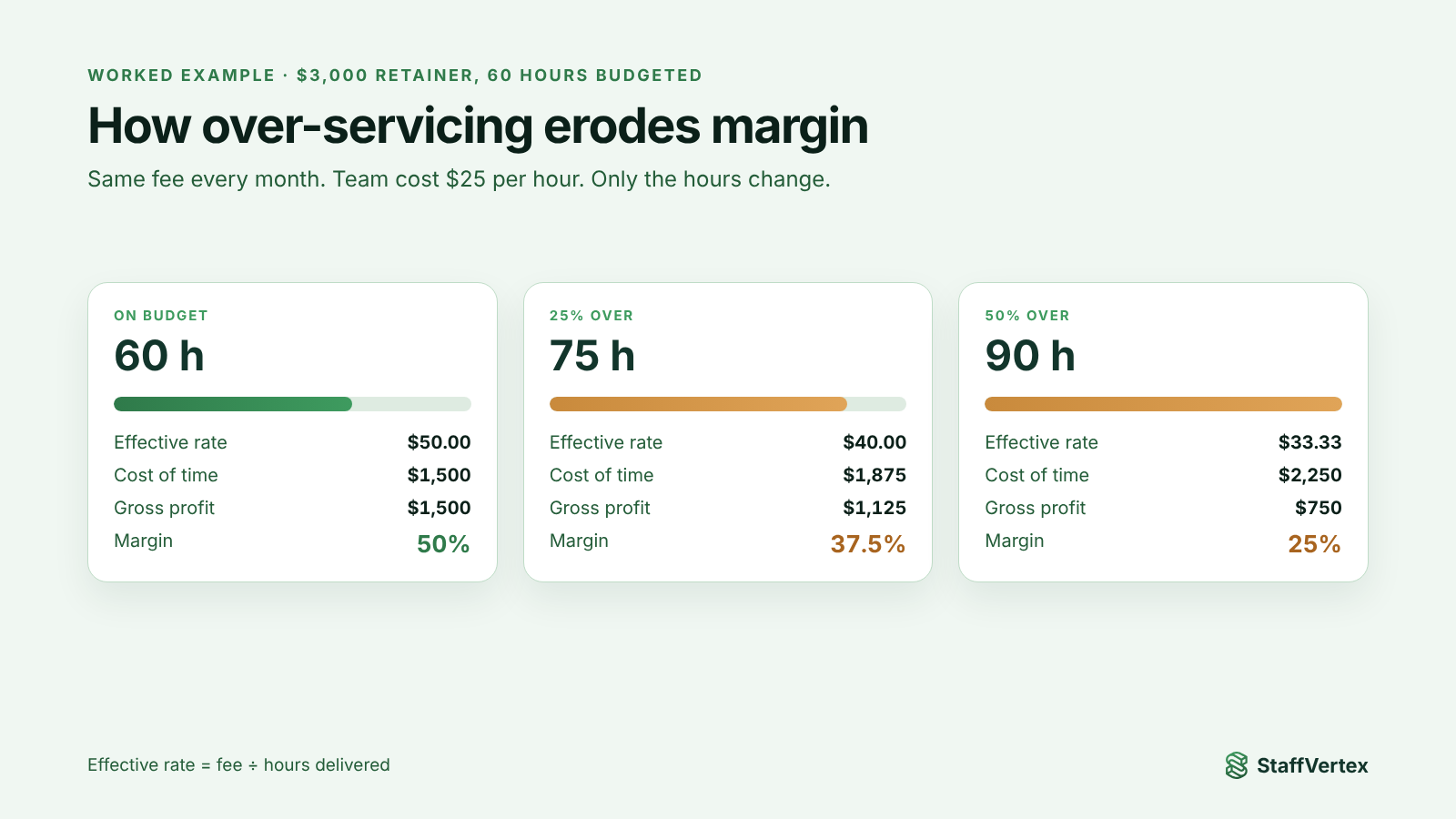
Worked example. A client pays a $3,000 monthly retainer. The agency priced it at a target effective rate of $50 an hour, so it budgets 60 hours a month. The blended cost of the team's time (salaries and overheads per hour) is $25.
Hours actually delivered | Effective hourly rate | Cost of time | Gross profit | Margin |
|---|---|---|---|---|
60 (on budget) | $50.00 | $1,500 | $1,500 | 50% |
75 (+25%) | $40.00 | $1,875 | $1,125 | 37.5% |
90 (+50%) | $33.33 | $2,250 | $750 | 25% |
The client pays the same $3,000 in every row. Without time tracking, the agency simply feels busier. With it, the account manager can see by week two that the retainer is heading for 90 hours and act: pull back, renegotiate scope, or propose an upgrade backed by real numbers.
How to structure time tracking for marketing agencies
One project per client engagement. A retainer, a campaign and an hourly support arrangement for the same client should be separate projects, so each can be measured against its own fee.
Mark the project type. Hourly projects are invoiced from hours; retainers and fixed-fee projects are not, but their hours still matter for profitability.
A consistent task list across clients. Using the same task categories everywhere makes cross-client comparisons possible. A typical set:
Strategy and planning
Content and copywriting
Design and creative production
Paid media management
SEO
Social media management
Reporting and analytics
Account management and client calls
Revisions and change requests
Make revisions visible. Track extra revision rounds and out-of-scope requests in their own task, so over-servicing shows up as a line you can discuss.
Track in real time. Creative work is full of short switches between clients. A desktop timer in the tray, started as you switch, captures far more than a Friday timesheet.
A monthly profitability routine
Set aside an hour at the start of each month to review the previous one.
Metric | How to calculate | What to do with it |
|---|---|---|
Effective hourly rate per client | Fee or revenue ÷ hours delivered | Rank clients; investigate any below your target rate |
Retainer burn | Hours used ÷ hours budgeted for the month | Flag clients above 100% two months in a row |
Revision share | Revision hours ÷ total hours per client | High shares point to unclear briefs or approval problems |
Billable utilization | Client hours ÷ total hours per person | Spot overload and under-use across the team |
Non-billable overhead | Internal, pitch and admin hours ÷ total | Keep it deliberate, not accidental |
Mid-month check. For retainers, also glance at burn around the 15th. If a client is already at 70% of budgeted hours, the account lead can act while there is still time.
Turn data into conversations. Share hours summaries with clients, especially on retainers. "We delivered 88 hours against a 60-hour scope this month" is a far stronger opening for a scope discussion than "we've been really busy."
How StaffVertex fits marketing agencies
StaffVertex gives agencies the structure above without a separate project tool:
Boards and cards for campaigns and deliverables, with assignees, deadlines and task dependencies, so every card carries the hours spent on it.
A tray timer on Windows and Mac with a global shortcut, for quick switches between clients, plus manual time for calls and meetings away from the desk.
Fixed or hourly projects. Retainers and project fees are tracked as fixed projects for profitability; hourly work carries a bill rate.
Automatic invoices for hourly work on Business, generated at the end of each cycle from the project's hours and bill rate.
Payslips for freelancers and staff paid by the hour, from the same tracked time.
Reports by project, person and client, so the monthly profitability review starts with numbers already in hand.
Offline tracking and idle prompts, so hours are complete and fair even for team members working on the move.
Pro is $4 and Business $9 per seat per month on monthly billing, with a 14-day free trial (pricing). For a 12-person agency, Pro costs $48 a month, less than an hour of one retainer's fee.
Try StaffVertex in your agency
Start a free 14-day StaffVertex trial, track one month of retainer work, and find out your real effective hourly rate per client. No card is required.