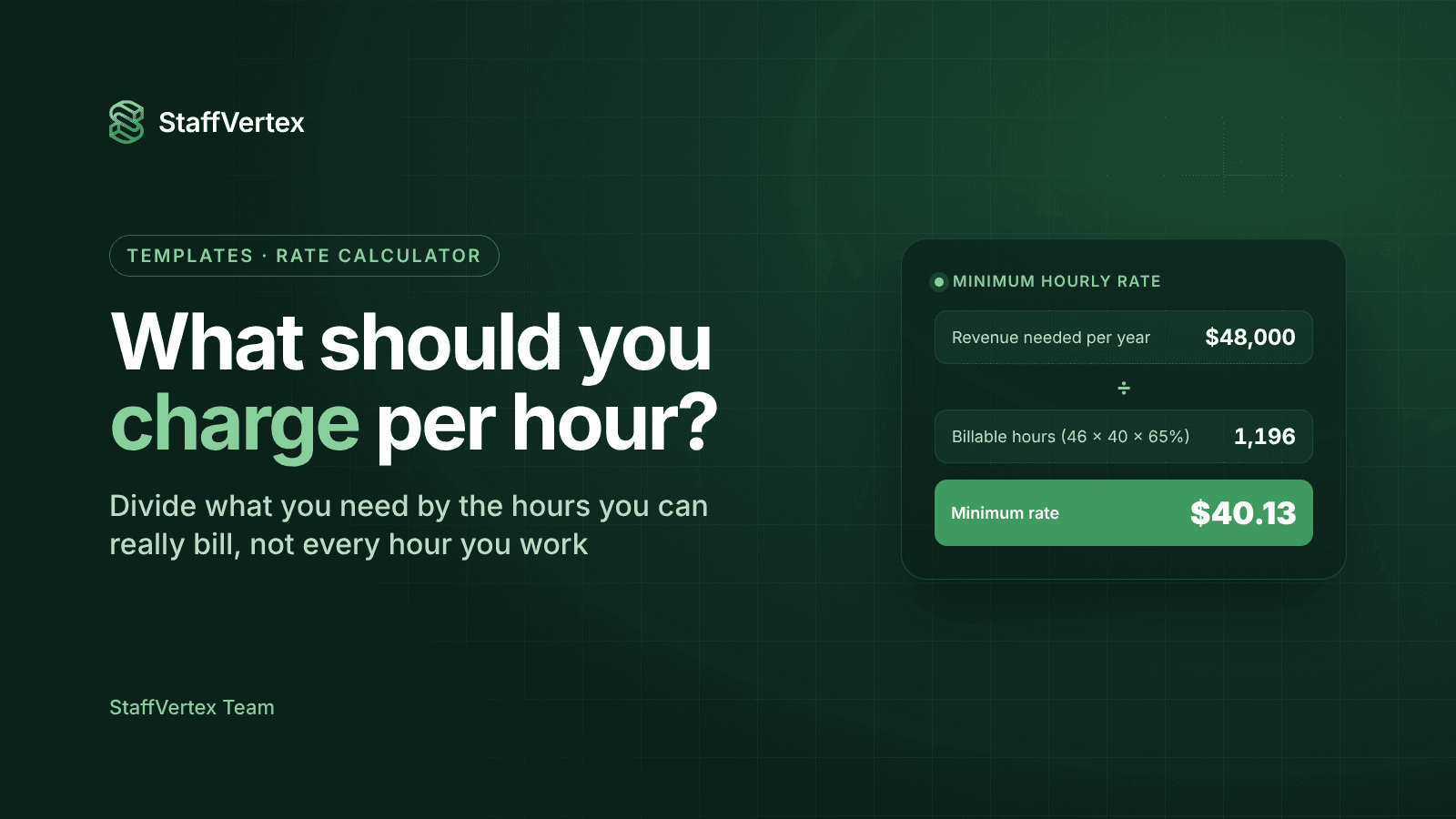
This billable hours calculator starts from one rule: your minimum hourly rate is the money you need to earn in a year divided by the hours you can realistically bill in a year. The mistake most people make is dividing by every hour they work, not just the billable ones, which sets the rate far too low.
Hourly rate = (target income + business costs + tax and buffer) ÷ billable hours per year
Billable hours per year = working weeks × hours per week × billable share
This guide turns that formula into a step-by-step calculator for freelancers and for agencies, shows how much your billable share changes the answer, and gives you a spreadsheet version you can reuse.
Billable hours calculator for freelancers
Step 1: Set your target income. What you want to take home in a year, as if it were a salary.
Step 2: Add your business costs. Software subscriptions, computer and equipment, internet, backup power, workspace, accounting, insurance, marketing and payment fees.
The U.S. Chamber of Commerce's guide to pricing your services explains how direct and indirect costs feed into a price.
Step 3: Add a buffer for tax, savings and quiet periods. Freelance income is uneven and you pay your own tax. A buffer of 20% or more of steps 1 and 2 is a sensible starting point; adjust for your tax situation.
Step 4: Count your working weeks. 52 weeks minus holidays, public holidays and sick days. Many freelancers land between 44 and 48.
Step 5: Choose your weekly hours. The hours you are willing to work, including admin.
Step 6: Estimate your billable share. Not every hour is billable. Sales calls, proposals, invoicing, learning and admin take time. Freelancers commonly bill 50% to 75% of their working hours.
Step 7: Divide.
Worked example
Step | Input | Value |
|---|---|---|
1 | Target take-home income | $36,000 |
2 | Business costs | $4,000 |
3 | Buffer (20% of $40,000) | $8,000 |
Revenue needed | $48,000 | |
4 | Working weeks | 46 |
5 | Hours per week | 40 |
6 | Billable share | 65% |
Billable hours per year (46 × 40 × 0.65) | 1,196 | |
7 | Minimum hourly rate ($48,000 ÷ 1,196) | $40.13, so round up to at least $41 |
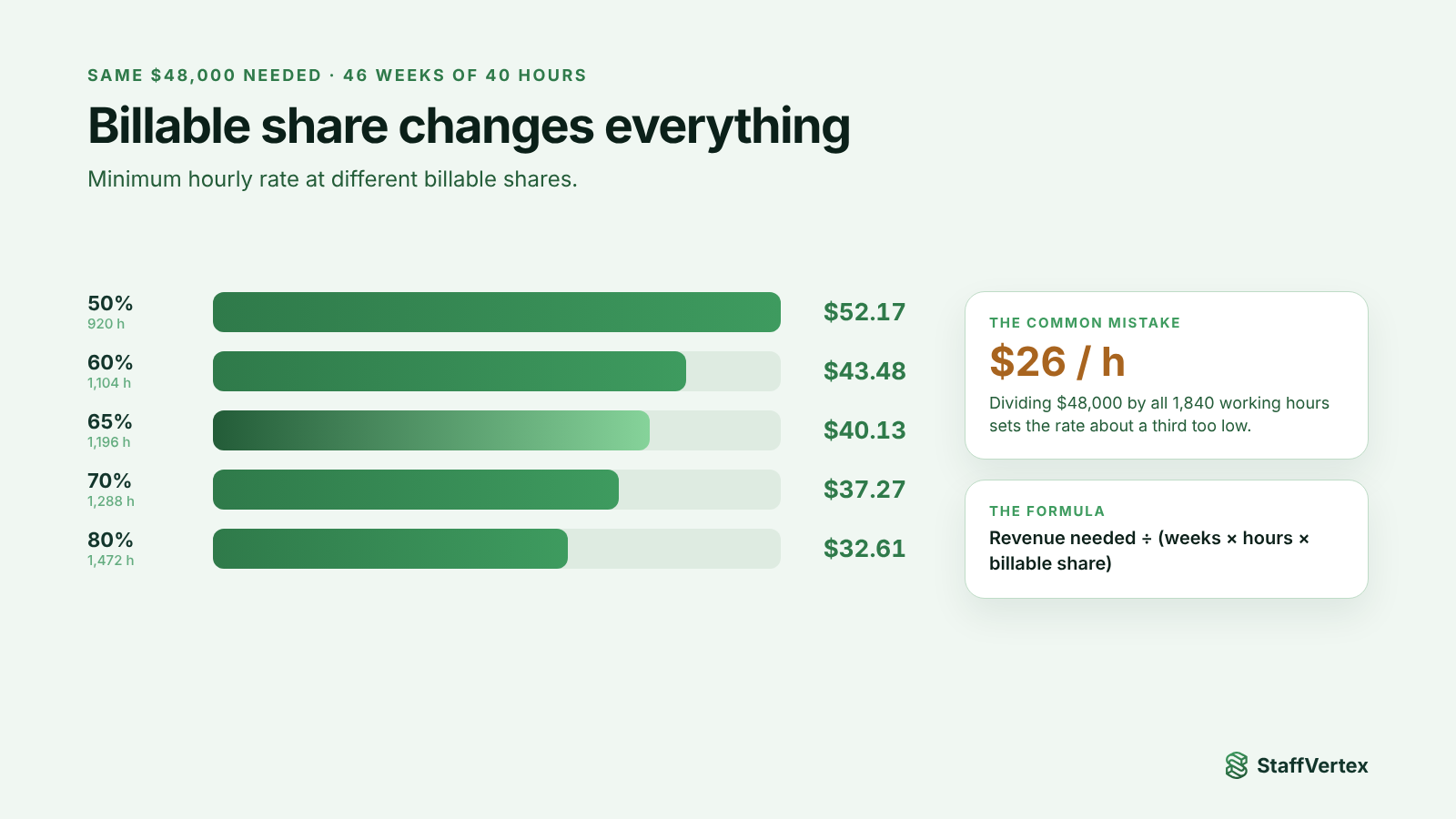
If you had divided $48,000 by all 1,840 working hours, you would have charged $26 an hour and fallen about a third short of your target.
How your billable share changes the rate
Using the same example ($48,000 needed, 46 weeks of 40 hours), here is the minimum rate at different billable shares.
Billable share | Billable hours per year | Minimum hourly rate |
|---|---|---|
50% | 920 | $52.17 |
60% | 1,104 | $43.48 |
65% | 1,196 | $40.13 |
70% | 1,288 | $37.27 |
80% | 1,472 | $32.61 |
Two lessons follow. First, if you are not sure of your billable share, assume a lower one; overestimating it is the most common reason freelancers undercharge. Second, raising your billable share, by tracking time properly so fewer billable minutes slip away, is worth as much as a rate increase.
Calculator for agencies and teams
Agencies and software houses price from the cost of a billable hour, then add the margin they need.
Fully loaded monthly cost = salary + benefits + share of office, tools and management
Billable hours per month = available hours × target utilization
Cost per billable hour = fully loaded monthly cost ÷ billable hours per month
Hourly rate = cost per billable hour ÷ (1 − target gross margin)
Worked example
Input | Value |
|---|---|
Fully loaded monthly cost of a developer | $2,000 |
Available hours per month | 160 |
Target utilization | 75% |
Billable hours per month (160 × 0.75) | 120 |
Cost per billable hour ($2,000 ÷ 120) | $16.67 |
Target gross margin | 50% |
Hourly rate ($2,000 ÷ 120 ÷ 0.5) | $33.33, so quote around $35 |
Margin versus markup. A 50% gross margin means charging double the cost per billable hour. If you think in markup instead, a 100% markup gives the same result. Mixing the two up is a common and expensive mistake.
Blended rates. For teams with different roles, calculate each role's rate, then set a blended rate for a project weighted by how many hours each role will spend on it.
Spreadsheet version
Build the freelancer calculator in Excel or Google Sheets by putting labels in column A and values in column B:
Cell | Label | Value or formula |
|---|---|---|
B1 | Target income | 36000 |
B2 | Business costs | 4000 |
B3 | Buffer % | 20% |
B4 | Revenue needed | =(B1+B2)*(1+B3) |
B5 | Working weeks | 46 |
B6 | Hours per week | 40 |
B7 | Billable share | 65% |
B8 | Billable hours per year | =B5*B6*B7 |
B9 | Minimum hourly rate | =ROUND(B4/B8, 2) |
B10 | Rate rounded up to nearest $5 | =CEILING(B9, 5) |
For the agency version:
Cell | Label | Value or formula |
|---|---|---|
B1 | Fully loaded monthly cost | 2000 |
B2 | Available hours per month | 160 |
B3 | Target utilization | 75% |
B4 | Billable hours per month | =B2*B3 |
B5 | Cost per billable hour | =ROUND(B1/B4, 2) |
B6 | Target gross margin | 50% |
B7 | Hourly rate | =ROUND(B1/B4/(1-B6), 2) |
Change any input and the rate updates instantly, which makes it easy to test "what if" scenarios before a pricing conversation.
Common pricing mistakes
Dividing by all working hours instead of billable hours.
Forgetting business costs, such as software, equipment, backup power and payment fees.
Leaving no buffer for tax, quiet months, illness and late payers.
Copying a competitor's rate without knowing their costs or utilization.
Never revisiting the rate. Costs rise; review your rate at least once a year.
Guessing your billable share. Most people overestimate it until they track their time.
Use tracked time to set better rates
The inputs that matter most, your real billable share and how long work actually takes, are exactly what time tracking tells you. After a month or two of tracking, you can replace guesses with facts:
Actual billable share: billable hours ÷ total tracked hours.
Effective hourly rate on fixed-price work: fee ÷ hours actually spent.
Estimate accuracy: actual hours ÷ estimated hours, per project.
StaffVertex makes this simple: a tray timer on Windows and Mac logs time against clients, projects and tasks, including offline; reports break hours down by project, person and client; and on Business, bill rates turn hours into invoices automatically. Plans start free for one person, with Pro at $4 and Business at $9 per seat per month on monthly billing (pricing).
Find your real numbers
Start a free StaffVertex account and track one month of work. You will know your true billable share, and your right rate, by the end of it.