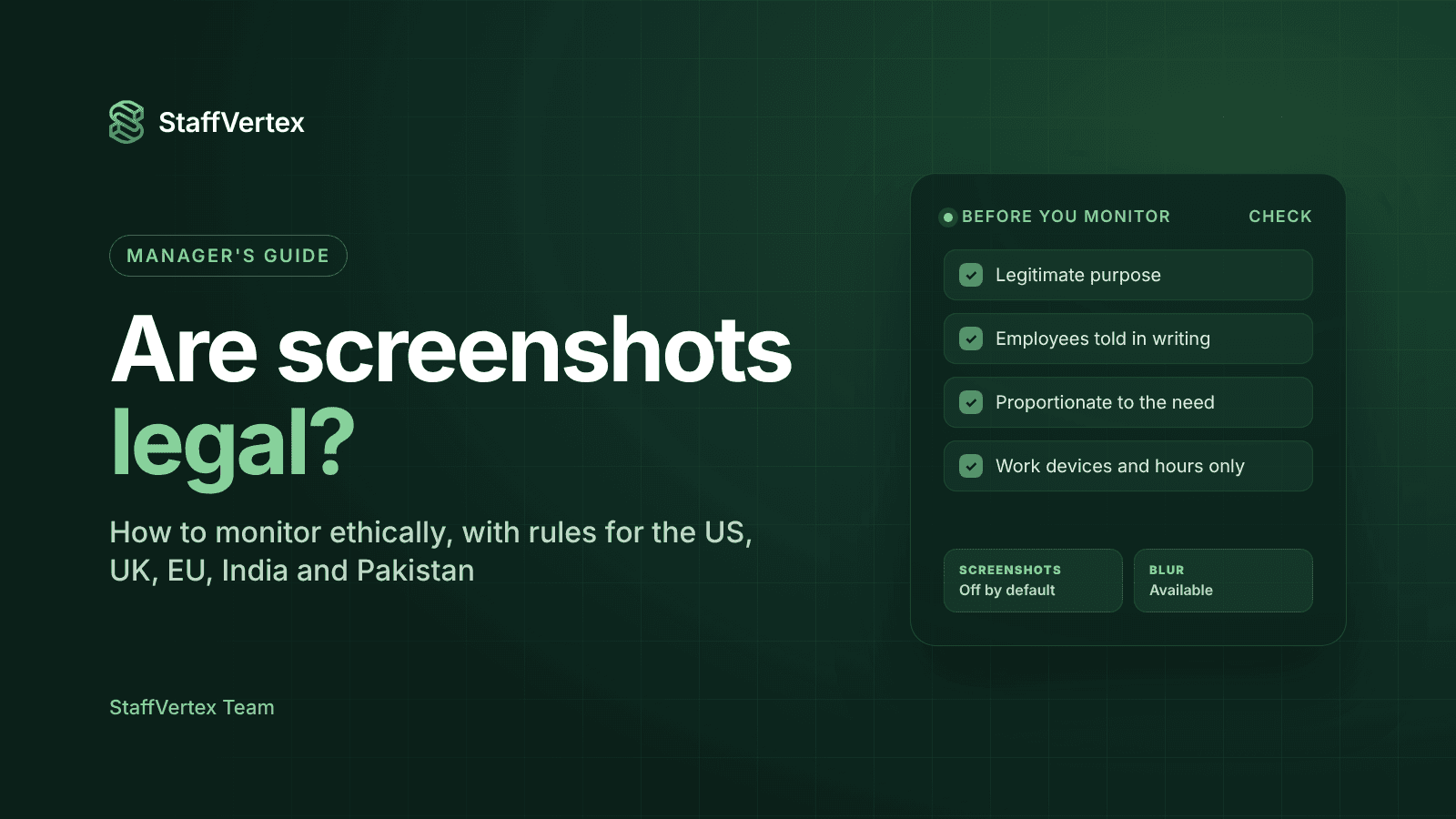
In most countries, taking employee screenshots on work computers during working hours is legal when employees are clearly told, the monitoring serves a legitimate business purpose, and it is proportionate to that purpose. What turns it into a legal or ethical problem is secrecy, capturing more than you need, monitoring personal devices or private time, and failing to protect the images.
The details vary a great deal by location. Some US states require written notice and acknowledgment. The UK and EU treat screenshots as personal data under GDPR, with strict rules on necessity and transparency. Other countries, including Pakistan, have no dedicated workplace-monitoring law yet but still recognize a right to privacy.
This guide sets out the principles that apply almost everywhere, summarizes the rules in the US, UK, EU, India and Pakistan, and gives you a practical checklist for monitoring ethically.
This article is general information, not legal advice. Laws change and depend on where your employees work. Consult an employment or data protection lawyer before introducing monitoring.
The principles that apply almost everywhere
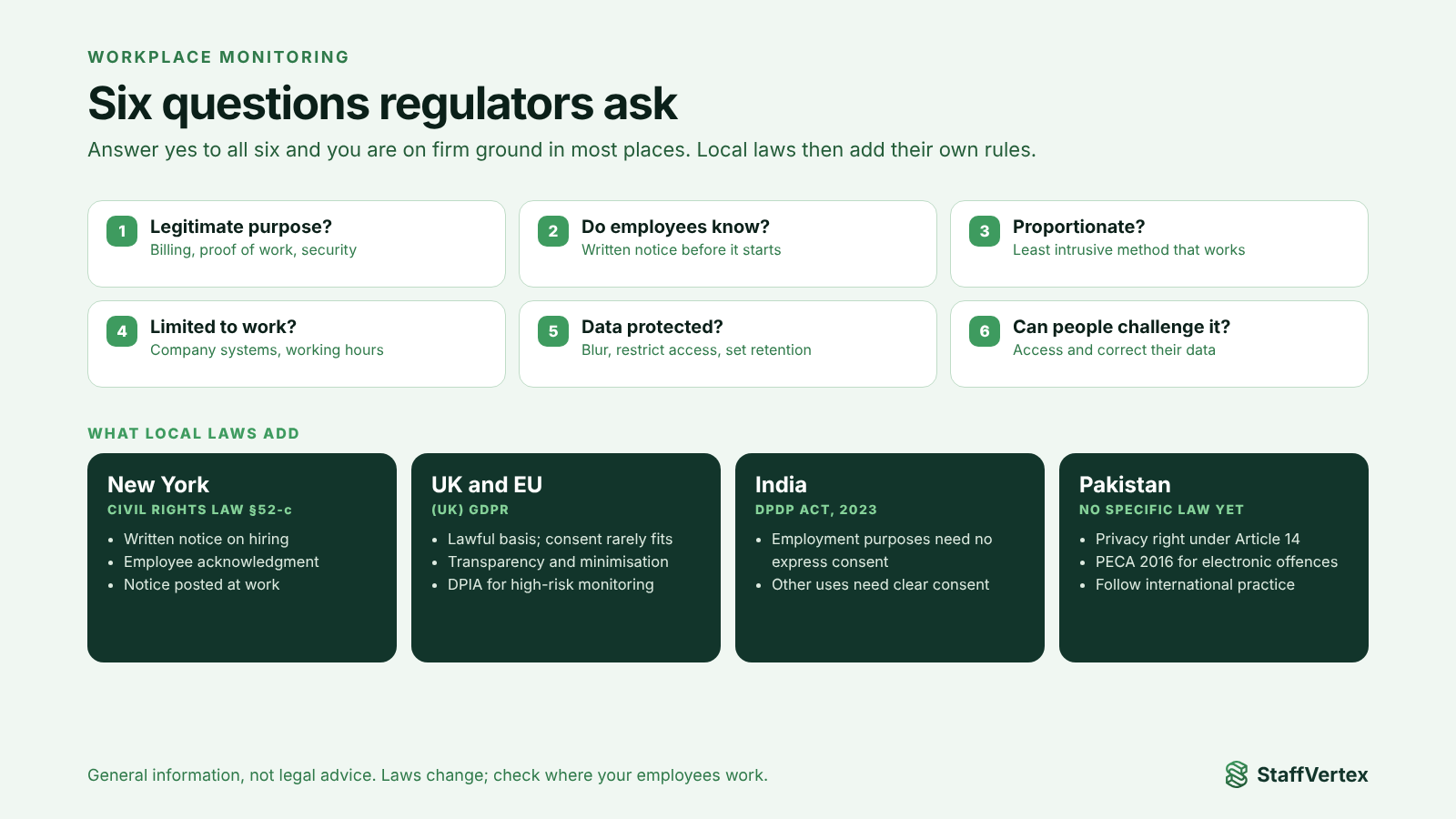
Whatever your jurisdiction, regulators and courts tend to ask the same six questions about workplace monitoring.
Is there a legitimate purpose? Client proof of work, accurate billing, security and compliance are common legitimate reasons. Curiosity is not.
Do employees know? Notice should be clear, in writing, and given before monitoring starts. Covert monitoring is rarely justifiable.
Is it proportionate? Use the least intrusive method that achieves the purpose. If hours and activity levels answer the question, screenshots may be unnecessary.
Is it limited to work? Monitor company systems during working hours. Avoid personal devices, private time and private spaces.
Is the data protected? Screenshots can capture passwords, health information or personal messages. Restrict access, blur where possible and set a retention limit.
Can employees see and challenge it? People should know how to access their data and correct mistakes.
If you can answer yes to all six, you are on firm ground in most places. The sections below explain where specific laws add requirements.
United States
There is no single federal law that bans screenshot monitoring of work computers. Employers generally have wide latitude to monitor company-owned systems used for business, especially when employees have been told. The main constraints come from state laws and from how the monitoring is done.
State notice laws. New York is the clearest example. Under New York Civil Rights Law §52-c, private employers with a place of business in New York that monitor employees' phone, email or internet access and usage must:
give prior written or electronic notice upon hiring to every employee subject to monitoring;
obtain the employee's written or electronic acknowledgment; and
post the notice in a conspicuous place.
Penalties, enforced by the state Attorney General, run up to $500 for a first violation, $1,000 for a second and $3,000 for each later one. Connecticut and Delaware also have electronic-monitoring notice laws, and more states have been considering similar rules, so check the states where your employees live and work.
Practical cautions.
Remote workers on personal devices raise the biggest risks. Screenshots of a personal laptop can easily capture family, health or financial information.
Protected activity, such as employees acting together on pay or working conditions, is protected by the National Labor Relations Act, and the NLRB bars employers from spying on or photographing it; monitoring that chills it can create legal exposure.
Audio and video recording are governed by separate wiretap and consent rules and need extra care.
United Kingdom and European Union
In the UK and EU, screenshots of an employee's screen are personal data, so monitoring must comply with GDPR (the UK GDPR in Britain). The UK Information Commissioner's Office (ICO) guidance on monitoring workers sets out what that means in practice. Note that the ICO says this guidance is under review following the Data (Use and Access) Act, so check for updates.
Key requirements from the ICO guidance:
A lawful basis. Employers must identify one. Consent is generally inappropriate in employment because of the power imbalance; another lawful basis, such as legitimate interests, may apply but requires balancing the employer's needs against workers' rights.
Transparency. Workers must be told how and why they are monitored. The ICO is clear that monitoring conducted without transparency is unfair.
Necessity and data minimization. Monitoring must be the least intrusive way to achieve the purpose, and you must not collect more than you need. The ICO gives the example that automatic webcam monitoring to check start times is likely to infringe data protection law, because less intrusive ways to check start times exist.
A DPIA for high-risk monitoring. A Data Protection Impact Assessment is required before high-risk processing; the ICO lists keystroke monitoring among its examples, and intensive screenshot monitoring is likely to need one too.
Special category data. If screenshots might capture health, trade union or similar sensitive information, you need an additional legal condition.
Covert monitoring only in exceptional cases, such as suspected criminal activity, authorized by senior management, time-limited and backed by a DPIA.
EU member states can add national rules, and in some countries works councils or employee representatives must be consulted before monitoring tools are introduced.
India and Pakistan
India. The Digital Personal Data Protection Act, 2023 governs employee data. According to DLA Piper's summary, employers may process employee personal data without express consent where it is a legitimate use for employment purposes or for protecting the employer from loss or liability, such as preventing corporate espionage. Processing beyond those purposes requires consent that is free, specific, informed, unconditional and unambiguous, given with a clear affirmative action. Employers should still tell staff what is monitored and keep collection proportionate.
Pakistan. Pakistan does not yet have a comprehensive data protection law. According to the Chambers 2026 practice guide, the draft Personal Data Protection Bill has completed consultation but has not been passed by both houses of Parliament, and there is no specific workplace privacy law. Privacy is protected as a fundamental right under Article 14 of the Constitution, and the Prevention of Electronic Crimes Act, 2016 addresses electronic offences involving personal data.
For Pakistani employers, especially those serving foreign clients, the practical approach is to follow international good practice anyway: written monitoring policies in employment contracts, notice before monitoring starts, work devices and hours only, and careful handling of screenshots. Clients in the UK, EU or US may also require you to meet their own data protection standards.
An ethical checklist for employee screenshots
☐ Write down the specific purpose, such as a client contract requiring proof of work.
☐ Check whether hours and activity levels alone would achieve it.
☐ Limit screenshots to the roles or projects that need them.
☐ Give written notice before monitoring starts and get acknowledgment.
☐ Put the policy in employment contracts or the handbook.
☐ Monitor only company devices during working hours, never private time.
☐ Blur screenshots by default where detail is not needed.
☐ Notify users when a screenshot is taken.
☐ Restrict access to the people who genuinely need it.
☐ Set and enforce a retention period.
☐ Complete a DPIA where GDPR applies and the monitoring is high risk.
☐ Review the setup every six months and remove what you no longer need.
How StaffVertex supports ethical monitoring
StaffVertex was designed so managers can meet these standards without extra tooling:
Screenshots are off by default. An administrator must choose to enable them.
Blur controls let you confirm work happened without exposing sensitive content.
Users are notified when a screenshot is taken, supporting transparency.
Timer-based tracking means monitoring only happens while the employee has started the timer for work, not whenever the computer is on.
Idle time is the employee's decision, which keeps records fair.
Role-based permissions let you restrict who can view screenshots and activity.
You remain responsible for your notices, policies and legal basis, but the tool will not push you into collecting more than you need.
Monitor responsibly with StaffVertex
Start a free 14-day StaffVertex trial with screenshots off by default, blur built in and user notifications, so you can add visibility only where it is justified.